
When you dream you always remember, when you wake you always forget. ~ Neil Gaiman (Sandman)
Happiness and Sleep Apnea
When I went in for my heart surgery, there was something I hadn’t thought about and that is the fact that throughout my whole recovery I would be sleeping on my back. I mean, I knew that I would be, but I hadn’t thought about sleep apnea. I’ve always known I had some level of apnea, an ex-girlfriend once told me I stopped breathing at night and it freaked her out. But I typically sleep on my side, and when I do I don’t snore and don’t have any significant level of problematic apnea as far as I can tell. Now, when they do sleep tests for apnea they count two things, all at ten second intervals, of either non-breathing or shallow breathing. So even on my side, I probably have some level of apnea, but once I get to sleep, I do at times suffer from insomnia, I sleep pretty well.
So while I was in the hospital, they noticed the apnea when they first started to cut down the oxygen they were giving me at night. So in order to sleep well in the hospital I convinced them to keep the oxygen flowing and I slept with a pillow tucked up under my chin to try and keep my mouth closed. Kind of a poor man’s version of CPAP. My doctor on the step-down floor suggested that I do a sleep test after I got out of the hospital.
I signed up for and got the sleep test done, it’s an odd little thing where you wear something on your finger and wrist while you sleep. When I did my appointment after the test I was told that I was experiencing 75 apnea events PER HOUR. I was of course still sleeping on my back. They offered me a CPAP machine to test out if it would help and I took it for two weeks. Now the way they do these trials is whacked. I decided to try it out for a nap at first and laid down, and as I nodded off and my mouth opened a bit, the CPAP kicked in with like 20 pounds of pressure, felt like someone was water boarding me. It took me about four different nap attempts before I could even nod off with the CPAP on. So I finally get the process dialed in a bit and sleep with the CPAP for a night and I wake up with a raging sore throat. The air pressure and dry air was the problem. So, now it was off to solve that problem, I’d read that using a saline nasal spray could help and so I went out to buy the spray. At the same time I found a saline nasal gel and bought that as well. In the end, the nasal gel absolutely helped but my throat was still a little sore when I woke up.
When I went in to return the unit and have my after appointment, they reviewed the data but it was all over the place. Happily I had a really reasonable technician who filtered out the goofy nights and determined that the CPAP was leaving me with about 15 events per hour, so I was a candidate to get a CPAP. After we talked about the issues I had, the technician related a few things. When I would get my own unit, it would have a humidifier so the air wouldn’t be so dry, and they would set it at 4 pounds of pressure instead of 20 pounds. When I got my unit, it was such an amazing difference. I had no problem immediately sleeping with it, my throat didn’t hurt and it really makes me wonder why they do the test in such an extreme manner. But more importantly, I wish they would have told me the pressure was adjustable and that there would be a humidifier with the permanent unit.
In the intervening two weeks while I waited for the unit to arrive I did some research about how to keep my mouth closed while using the CPAP. At first I ordered a chin strap. While it worked when it was on, there were two problems. During the night as I tossed and turned sometimes I would knock the chin part off and it would be completely off when I woke up. Another issue was that it had to be tight, and the straps across my head would leave dents each morning when I woke up. Not an issue for those of you with hair, but honestly I’m at least a little too vain to walk around every morning with strap marks across my dome.
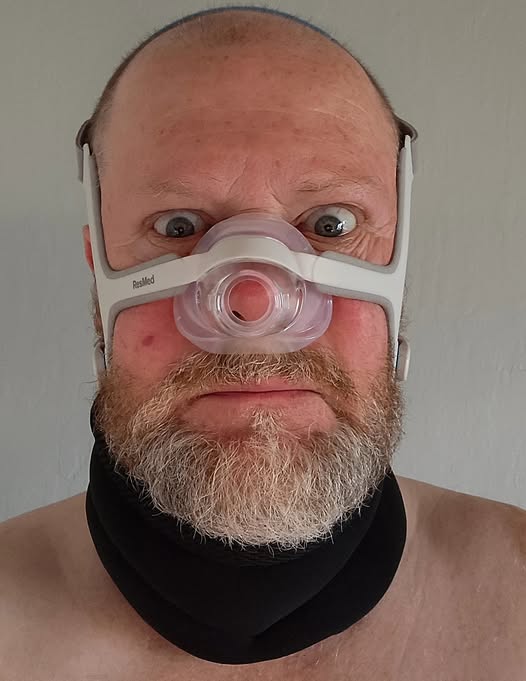
Then I saw something, a neck collar that is supposed to keep your mouth closed and your head in a position that keeps you from snoring. There is a name brand one for $40 or $50 depending on where you get it from, but I bought a generic one for about $19 dollars on Amazon. Here it is:

I tried it out on a couple of day vacation and it was a little uncomfortable but I quickly got used to it and it seemed to keep me from snoring. A few days later I got my CPAP and started wearing the full, lovely gear set up pictured above. The unit tells you how many events per hour you have during the night. Immediately on the first night, the number of events dropped to 1.6 per hour. Since then my nightly events have ranged between 0 and 1.6 per hour with the average being about 0.5 per hour. This means that my apnea events in an eight hour night have dropped 600 to 4, which is pretty amazing. I’ve actually requested to do another sleep test so that I can wear the collar without the CPAP. While I’m guessing the combination is the trick, and I can see what the CPAP alone does, if the neck collar alone is getting me to low numbers, I really don’t need to do both. Certainly, for traveling, I can take just the neck collar, a lot easier to pack and carry.
Fixing your apnea is supposed to do a lot of things for you. A lot you can’t see, it’s supposed to lower your risk of heart attacks, help you control your diabetes better, and help with a range of things including depression, anxiety, acid reflux and even chronic pain. You’re supposed to feel less tired and more energetic during the day. So it’s a good thing to do. However, like most things, the most frequent question I get post surgery is, “do you feel so much better?” The answer is no, I had no actual symptoms pre-surgery, but I don’t worry about an aneurysm blowing out and killing me if I strain too hard weight lifting or if I get hit in the gut, so better, but not a noticeable physical change. The change I’ve seen with the new set up is that I’m actually sleeping fewer hours and feeling the same level of rested. I’m someone who to feel rested usually needs between eight and nine hours of sleep, always have. With the set up, I’ve been pretty consistently waking up naturally between seven and eight hours of sleep. So that’s definitely a benefit. All in all a good thing. So people who are really struggling with their sleep and have apnea, I absolutely think it’s a good idea. And better sleep makes for happier days my friends. ~ Rev Kane

 The Ministry of Happiness